Airway and Breathing in Orthodontics – Part 2 of 3
The phrase airway assessment can sound as though an orthodontist is carrying out a sleep study. We are not.
An airway-aware orthodontic assessment is a structured way to notice clues that may otherwise be missed, ask useful questions, and involve the right medical practitioner when needed.
At Adelaide Orthodontics, the order is simple: observe, ask, refer and support. Orthodontic treatment is recommended only when there is a genuine orthodontic indication, and it does not replace ENT or sleep medicine.
Does Every Child Need a Sleep Questionnaire?
No. I do not believe every patient needs a long sleep form at every visit.
Every child does receive a routine clinical assessment that is aware of breathing and oral posture. When the history or examination raises a concern, I ask targeted questions based on useful domains from the validated Pediatric Sleep Questionnaire.
A questionnaire can help identify risk. It cannot diagnose obstructive sleep apnoea. The questions I find most useful cover:
- Snoring: Is it more than occasional, or loud enough to hear from another room?
- Pauses or effort: Has anyone noticed gasping, choking, pauses or struggling to breathe?
- Sleep quality: Is sleep restless, sweaty, interrupted or spent in unusual positions?
- Mouth breathing: Is the mouth open during sleep, concentration, exercise or quiet rest?
- Daytime signs: Is there tiredness, irritability, low energy or an attention concern?
- ENT and family history: Are there allergies, repeated nasal blockage, large tonsils or a family history of snoring and sleep apnoea?
A family history is often useful. Parents will sometimes say, “Dad snores like a train.” That does not prove the child has the same problem, but it adds context to the rest of the assessment.
What Do We Look For During the Examination?
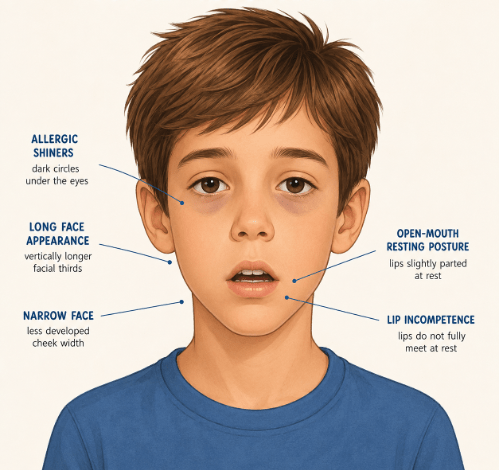
Face, Lips and Resting Posture
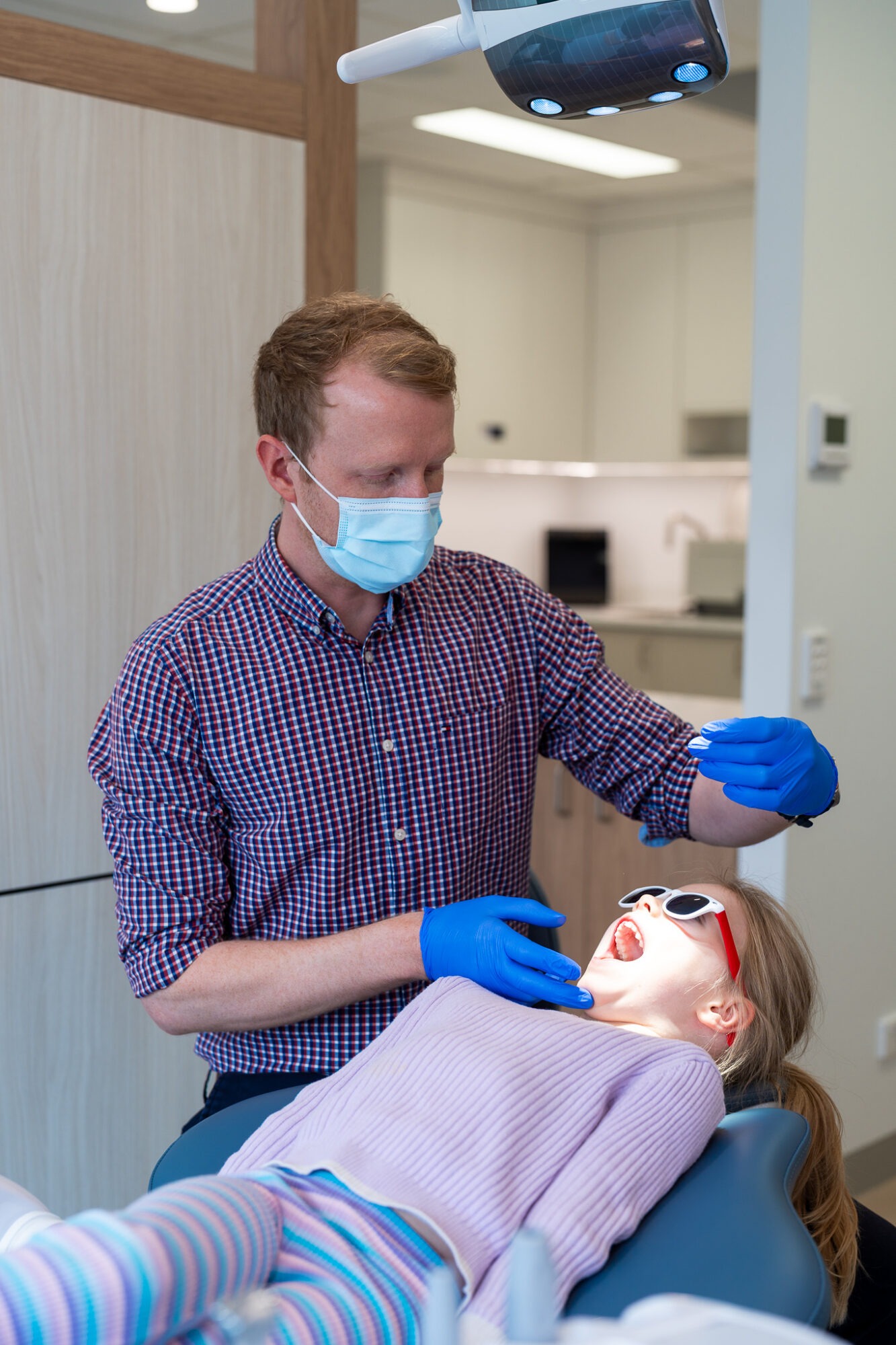
We look at the child while they are sitting, listening and talking – not just when they are asked to bite together for a photograph.
Clues can include lips that remain apart at rest, an open-mouth posture, signs of chronic nasal obstruction, allergy-related dark circles, and a longer facial growth tendency. None of these findings is diagnostic on its own.
Inside the Mouth
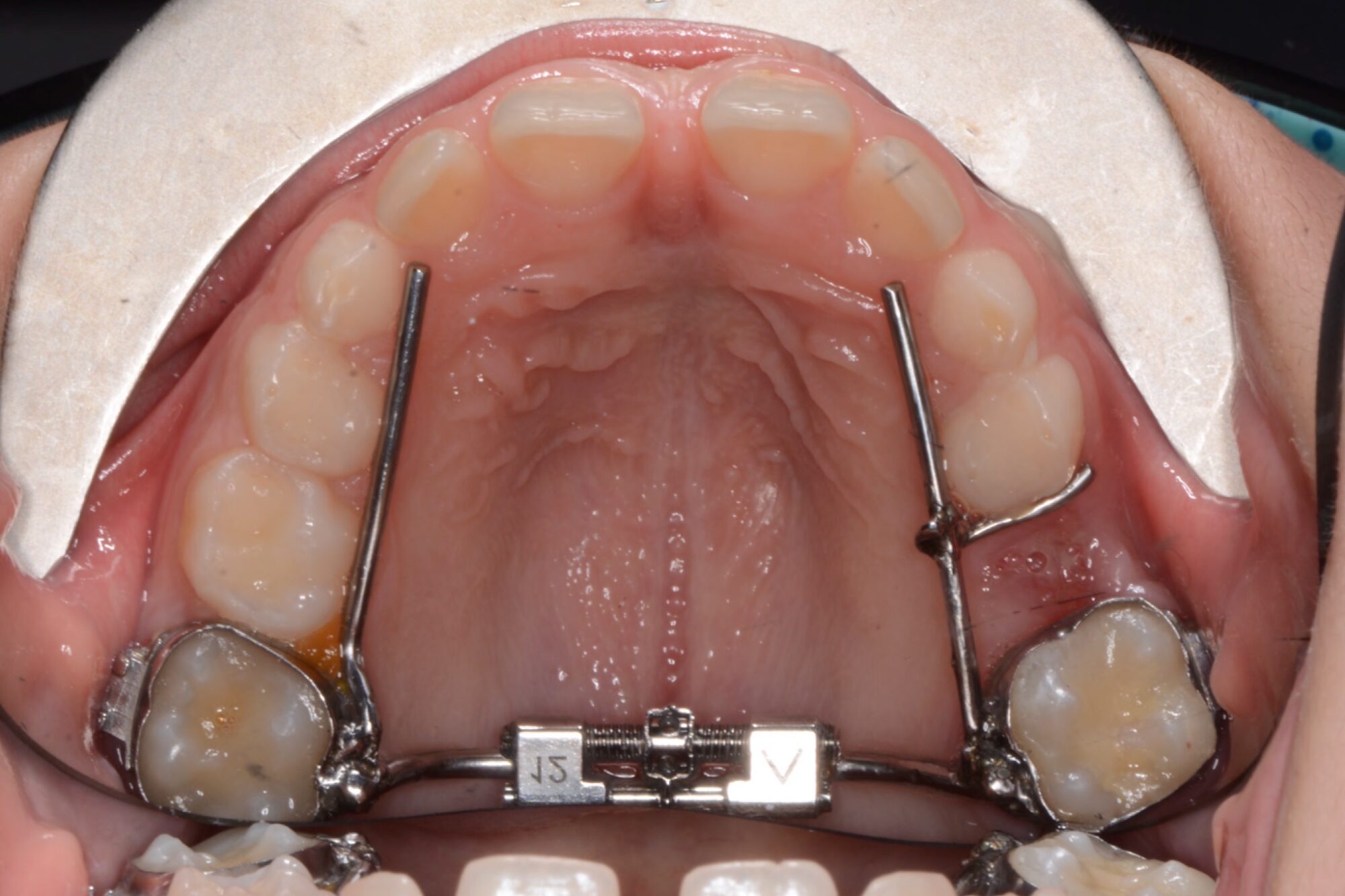
The oral examination includes the width and shape of the upper jaw, the height of the palate, the amount of crowding, the way the upper and lower teeth meet, and the eruption path of the adult teeth.
We also look for a posterior crossbite, dry mouth, gum irritation, visible tonsil enlargement and the resting posture of the tongue and lips.
The Bite and Growth Pattern
A narrow maxilla can show up as a crossbite, a functional shift of the lower jaw, reduced arch space or a high palate. We consider those findings alongside the child’s stage of growth, because treatment timing can change the type of response we expect.
Clinical rule: One sign is not enough. The combination of history, symptoms, clinical findings and growth pattern determines whether referral is sensible.
What Can X-Rays and Scans Tell Us?
If a lateral cephalometric X-ray has already been taken for a genuine orthodontic reason, it may show an enlarged adenoid shadow or a reduced space behind the nose. That can support a referral, but it is not a definitive airway test.
An X-ray is a static image taken while a child is awake. Sleep-disordered breathing is dynamic and occurs during sleep. A cone beam CT scan can show three-dimensional anatomy, but it still does not diagnose sleep apnoea and should only be used when clinically justified.
We do not take extra imaging simply to put a number on an airway.
When Do We Refer to ENT or Sleep Medicine?
Referral is usually recommended when symptoms and clinical signs point in the same direction.
- Night-time breathing symptoms: regular snoring, gasping, witnessed pauses, restless sleep or unusual sleeping positions
- Daytime effects: persistent tiredness, irritability, concentration concerns or morning headaches
- Obstruction signs: large tonsils, suspected adenoid enlargement, chronic mouth breathing or ongoing nasal blockage
- Orthodontic findings: a narrow upper jaw, high palate, crossbite or significant crowding, especially when symptoms are also present
The purpose of referral is to confirm or rule out obstruction and identify the cause. An ENT specialist can assess the tonsils, adenoids and nasal airway. A GP, paediatrician or sleep physician may co-ordinate further investigation, including a sleep study when appropriate.
What Happens After a Referral?
There is no single sequence that suits every child.
- Medical or ENT care first: This is usually prioritised when symptoms are severe or there is clear obstruction.
- Parallel care: ENT review and orthodontic treatment may proceed together when there is a strong orthodontic indication and it is medically appropriate.
- Monitoring: Mild or uncertain findings may simply be observed, with clear advice about what changes should prompt review.
The pathway is based on obstruction severity, the child’s growth, the orthodontic problem and the family’s concerns.
What an Orthodontic Assessment Cannot Promise
- A facial pattern, narrow palate or crossbite cannot diagnose sleep apnoea.
- A questionnaire identifies risk; it does not provide a medical diagnosis.
- An airway measurement on an X-ray or CBCT does not show how the airway behaves during sleep.
- Expansion does not guarantee that snoring or sleep symptoms will resolve.
- A normal-looking bite does not rule out a sleep or breathing disorder.
Why the Whole Dental Team Matters
The first person to notice a pattern is often not the orthodontist. An oral health therapist or hygienist may see an open-mouth posture. A dentist may hear about snoring. An orthodontist may then connect that history with the palate, bite, growth pattern and records.
That is the real value of an airway-aware dental examination: early recognition and a timely referral, without overstepping the limits of dental diagnosis.
The Bottom Line
An airway-aware orthodontic assessment is careful, targeted and multidisciplinary. It is not a label and it is not a promise that an orthodontic appliance will solve a sleep problem.
The goal is to make sure important clues are not missed and that each child reaches the right practitioner at the right time.
For an assessment of your child’s teeth, bite and jaw development, you can book a consultation with Dr Sven Dr Mimi in Unley or Hahndorf.
Previous: Mouth Breathing, Snoring and Orthodontics: What Parents Should Look For
Next: Can Palatal Expansion Improve Breathing? What the Evidence Actually Says
Dr Sven
Sources and Further Reading
- Chervin et al. Pediatric Sleep Questionnaire: validity and reliability
- American Academy of Pediatrics: Diagnosis and Management of Childhood Obstructive Sleep Apnea Syndrome
- Rinchuse et al. Avoid overstepping the bounds of evidence: the role of the orthodontist in managing paediatric OSA
- Savoldi et al. The use of CBCT in orthodontics with special focus on upper airway analysis
This article provides general information only and does not diagnose or replace medical assessment for a sleep or breathing disorder.