
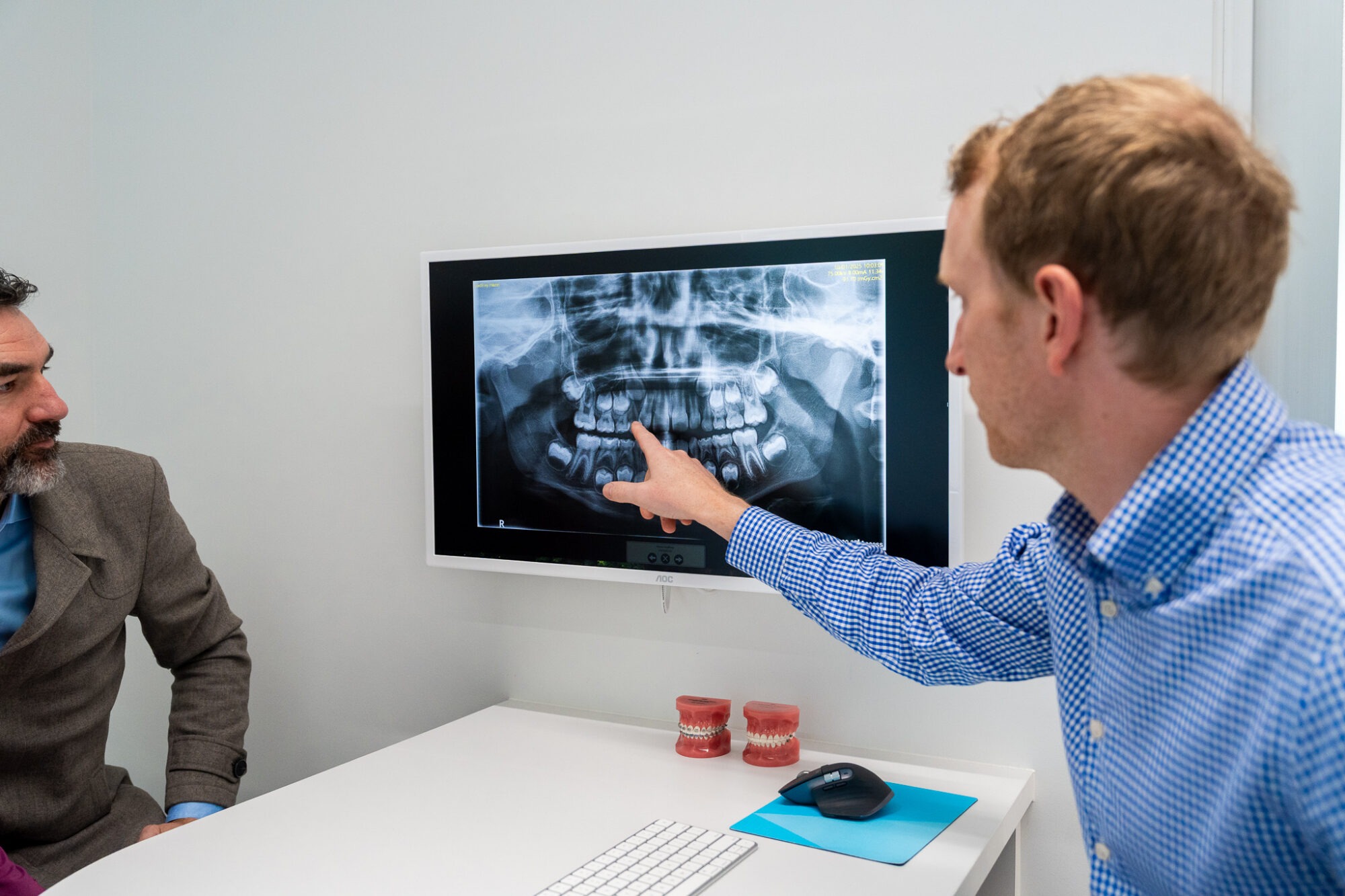
When an upper adult canine is not erupting in the right position, one possible early treatment is to remove the baby canine. This can give the adult tooth a better opportunity to improve its path and erupt naturally.
However, removing the baby tooth does not help every child. The position of the adult canine, its angle and the child’s stage of dental development all matter.
What is a palatally displaced canine?
The upper adult canine normally erupts beside the lateral incisor. A palatally displaced canine is developing too far towards the roof of the mouth rather than following its usual eruption path.
This may be noticed because the baby canine remains in place, the adult canine cannot be felt in the expected position, or the tooth appears off course on the OPG.
Why might the baby canine be removed?
Removing the retained baby canine can create a clearer eruption path for the adult tooth. In suitable cases, this may reduce the chance of the canine becoming more deeply impacted and needing surgical exposure and orthodontic traction later.
The important question is not simply whether the adult canine is displaced. It is whether its position is favourable enough to respond to this early treatment.
What did the study look at?
A randomised clinical trial followed 67 children aged 10 to 13 with one or two palatally displaced upper canines. Some had the baby canine removed, while others were monitored.
The researchers used the OPG to assess two main features:
- The alpha angle: how steeply the adult canine was angled towards the centre of the mouth.
- The sector: how far the crown of the canine overlapped the neighbouring front teeth.
What did they find?
The position of the canine on the OPG helped predict whether removing the baby canine was likely to be useful.
- Less than 20 degrees and in sector 2: the canine could often be monitored, as it may erupt without removing the baby tooth.
- Between 20 and 30 degrees and in sectors 2 to 3: removing the baby canine was most likely to be beneficial.
- More than 30 degrees and in sector 4: removing the baby canine alone was unlikely to be enough, and earlier surgical exposure may need to be considered.
Younger children and canines with less advanced root development also had a better chance of erupting.
Does every retained baby canine need to be removed?
No. Some mildly displaced canines may improve with careful monitoring, while more severe cases may need space creation, braces or surgical exposure.
The study also found minor side effects after extraction in some children, including small midline changes or neighbouring teeth moving into the space. This is one reason ongoing orthodontic review is important.
It is also important to note that the study only included children without significant crowding in the upper arch. When there is a lack of space, the treatment plan may need to address the crowding as well.
What does this mean for your child?
Early assessment gives us more options. The OPG can help determine whether it is best to monitor the canine, remove the baby tooth, create more space or consider surgical treatment.
Even when no treatment is needed immediately, the canine should be reviewed until it has erupted or a clear treatment plan has been made.
The bottom line
Removing a baby canine can be a simple and useful early step, but only when the adult canine is in a position that is likely to respond. The angle and location of the tooth on the OPG help guide that decision.
If your dentist has raised concerns about an ectopic, delayed or unerupted upper canine, book a consultation with Dr Sven at Adelaide Orthodontics. Early assessment may make future treatment more straightforward.
This information is general in nature and does not replace an individual orthodontic assessment.
Source: Naoumova J, Kjellberg H. The use of panoramic radiographs to decide when interceptive extraction is beneficial in children with palatally displaced canines based on a randomized clinical trial. European Journal of Orthodontics. 2018. View the study.